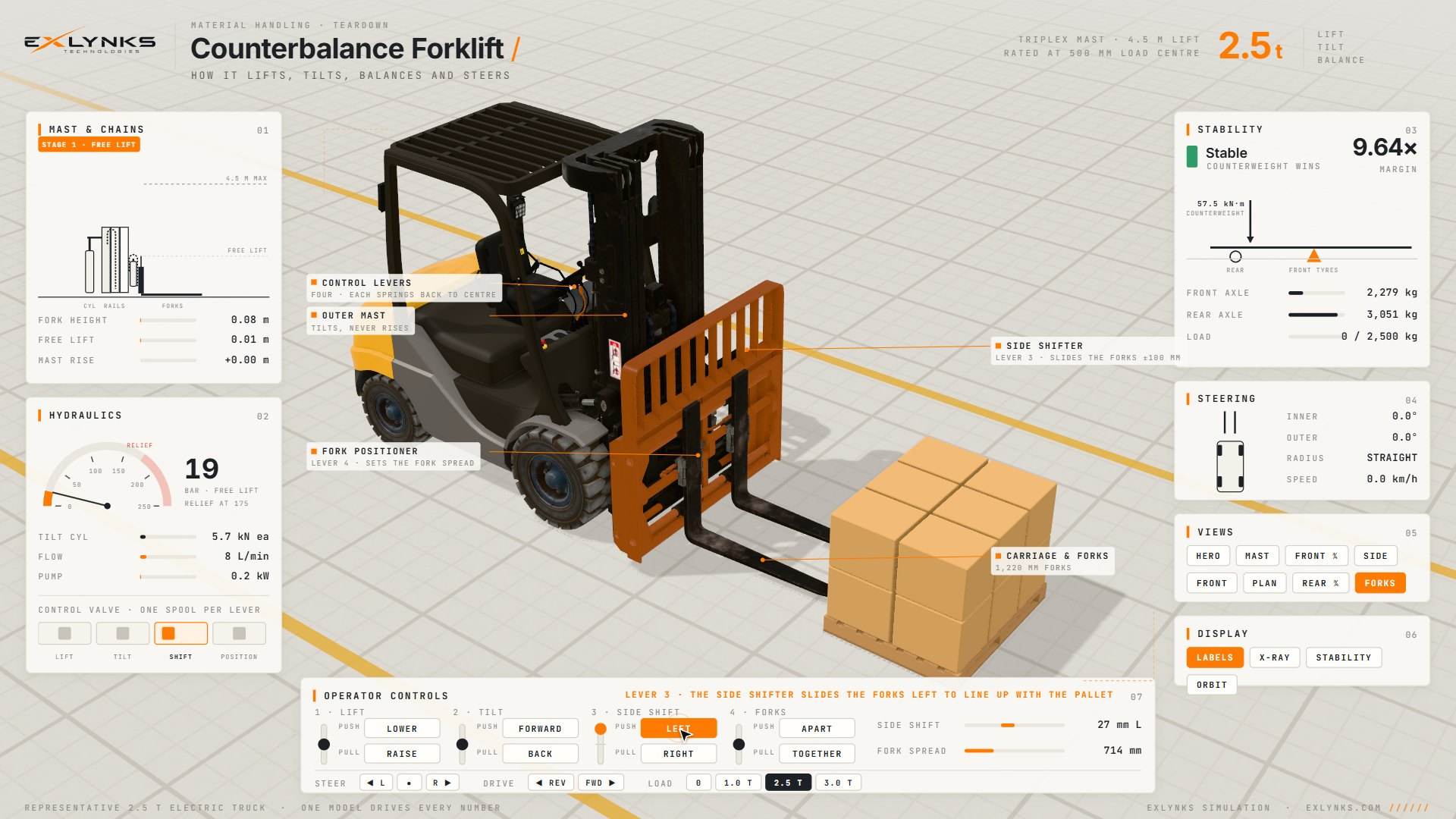
The counterbalance principle
A counterbalance forklift carries its load in front of its front wheels, with nothing underneath it. What stops it tipping forward is the truck itself: the counterweight and, on an electric truck, the battery, behind the rear axle. The front wheels are the pivot of a seesaw. The load and the mast press the front down; the counterweight holds the back down.
On a representative 2.5 t electric truck, the body, counterweight and battery weigh about 4.2 t and sit, on average, about 1.4 m behind the front axle. With 2.5 t on the lowered forks, about 6.8 t rests on the front axle and about 1.0 t on the rear: the truck is stable, but most of the weight has moved onto the front wheels.
Load centre and rated capacity
A forklift’s capacity is rated at a stated load centre: the distance from the face of the forks to the centre of gravity of the load, 500 mm on many trucks of this class. Move the load’s centre further out, with a long load or one pushed to the fork tips, and its tipping moment grows, so the safe capacity falls.
The capacity plate on the truck gives the figures for its mast and attachments. It is the rule, not a guide.
The stability triangle
Most counterbalance trucks stand on three points, not four: the two front wheels and the pivot at the middle of the rear steer axle, which rocks so the rear wheels follow the floor. The combined centre of gravity of the truck and its load has to stay inside that triangle for the truck to stay upright.
Raising the load raises the combined centre of gravity, so smaller shifts can carry it over an edge: a forward tilt, a turn taken fast, a slope, or a sudden stop. That is why the same load that is safe at floor level needs more care at height.
The mast: free lift and the 2 : 1 chain
The mast is a set of nested rails: two on a duplex mast, three on a triplex. The forks hang on a carriage that rolls up the innermost rail. Leaf chains anchored at one end run over a sheave (a pulley) on the head of a moving rail and down to the part it lifts, so when that rail rises one metre, the part on the chain rises two. That 2 : 1 ratio is how cylinders shorter than the lift height reach the top.
Many triplex masts have full free lift: a cylinder in the middle of the mast first lifts the carriage up the inner rail while the mast stays at its lowered height, which matters inside containers and under low doors. Only then do two cylinders behind the rails extend the mast, and the inner rail rises twice as far as the middle one. On our representative truck the forks rise 1.55 m in free lift before the mast starts to grow, and reach 4.5 m at full extension.
Hydraulics: pump, valve and cylinders
An electric motor drives a gear pump that sends oil to a control valve with one spool for each lever. Pull the lift lever and the valve sends oil to the lift cylinders; push it and the valve lets the oil out, and the weight of the load lowers the forks while a flow control keeps the speed in check, so the pump does no work on the way down. A relief valve caps the pressure: a load too heavy to lift simply stays where it is.
On our representative truck, holding 2.5 t takes about 147 bar in the free-lift cylinder and about 134 bar in the main lift cylinders, against a relief setting of 175 bar. With the pump delivering 45 litres a minute, the forks rise at about 0.39 m/s in free lift and 0.32 m/s as the mast extends, because the main cylinders have more area to fill.
Tilting the mast
Two tilt cylinders between the frame and the mast tilt it back, to cradle the load against the backrest for travel, and forward, to set the load level in a rack. Tilting forward moves the load’s centre of gravity forward, and the higher the load, the further it moves.
On our representative truck, 2.5 t raised to 4.4 m and tilted fully forward leaves only about 100 kg on the rear axle: the margin against tipping is down to about 3 per cent.
Rear-wheel steering and tail swing
A counterbalance forklift steers with its rear wheels. That lets it turn almost about a point on its front axle line, so it can swing into an aisle not much wider than its own length. The price is tail swing: the back of the truck, the heavy counterweight, swings out wide on every turn, which is why operators check behind and to the side before turning.
A steering cylinder in the rear axle turns both wheels through short links to their knuckles, the inner wheel further than the outer, so both roll around the same centre (Ackermann steering).
Side shifter and fork positioner
A side shifter slides the forks and the load sideways, typically about 100 mm each way, so the operator can line up with a pallet or a rack position without repositioning the truck. A fork positioner moves the forks apart or together to suit different pallets, usually with the forks unloaded.
The four levers
The hydraulic functions are worked by levers beside the operator, often one per function: lift, tilt, side shift and fork position. Each is a three-position control on a spring: push it one way, pull it the other, and let go to stop, when it springs back to the middle. Pull to raise or tilt back; push to lower or tilt forward.
Safe habits that follow from the physics
Travel with the forks low and the mast tilted back. Tilt forward with a raised load only when it is directly over the stack. Never exceed the capacity plate, and remember that capacity falls as the load centre moves out. Watch the tail swing on every turn, and slow down before turning, not during the turn.
The figures on this page are representative values for a 2.5 t electric counterbalance truck with a triplex mast, from the model behind our interactive teardown, not a manufacturer’s datasheet. Your truck’s capacity plate and operator’s manual always come first.